 |
Moteur de recherche de fiches techniques de composants électroniques |
|
|
Moteur de recherche de fiches techniques de composants électroniques |
|
The question interval is too short.
Please try again in a few seconds.

Hello, Please ask a question about EM73880 Datasheet
# Example questions:
➢ Explain how the hl register is utilized *both* as a general purpose register and as a memory pointer, providing an example of each use case.
➢ Explain the function of the stack pointer (sp) in the em73880 microcontroller, including how it's initialized and modified during subroutine calls and returns.
➢ Describe the different operation modes (normal, slow, idle, stop) of the em73880, detailing which functionalities remain available in each mode and how the system clock is affected.
| Part No. | EM73880 |
| Manufacturer | EMC |
| Size | 222 Kbytes |
| Pages | 40 pages |
| Description | 4-BIT MICRO-CONTROLLER FOR LCD PRODUCT |






1. General Overview
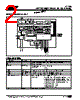
️· Target: This is a 4-bit microcontroller designed for LCD (Liquid Crystal Display) applications, specifically targeting control and display functionality. It's a relatively simple, low-power device.
️· Documentation Style: The documentation is a bit terse and uses a table/list-based approach. It's not a tutorial; it's more of a reference guide.
2. Core Architecture & Registers
️· Data Size: Operates on 4-bit data. This means it processes data in chunks of 4 bits, which is a limitation compared to 8-bit or 16-bit microcontrollers.
️· ALU (Arithmetic Logic Unit): Handles arithmetic (addition, subtraction) and logical operations. It has flags (CF - Carry Flag, ZF - Zero Flag, SF - Status Flag) to indicate the results of these operations.
️· HL Register: This is a crucial register. It serves multiple purposes:
- Pointer: Used for accessing RAM memory locations. (Memory address)
- Temporary Storage: Can be used to temporarily hold data during calculations.
- I/O Port Control: The lower nibble (L) can be used as a pointer to select bits of an I/O port (likely Port 4).
️· SP (Stack Pointer): Manages the stack, which is used for storing return addresses when calling subroutines and for temporary data. It's a 4-bit register, limiting the stack depth.
️· DP (Data Pointer): A 12-bit register that points to locations within ROM (Read-Only Memory). This is useful for accessing program code or constants stored in ROM.
️· HL Register: A pair of 4-bit registers used as a pointer and as temporary registers.
3. Memory and Addressing
️· RAM: Limited, but crucial for data storage. HL register functions as a memory pointer.
️· ROM: Used for program storage and constants. DP provides access.
️· Stack: Limited to a 4-bit depth due to the SP register.
4. Clock and Timing
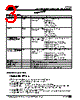
️· Dual Clock System: A combination of low-frequency (from crystal or RC oscillator) and high-frequency internal clocks.
️· Clock Frequency: Low frequency (~32.768 kHz - suitable for low-power operation, often used in watches). The High frequency oscillator is built-in at 4.6 MHz.
️· Operating Modes:
- NORMAL: High-speed operation, suitable for demanding tasks (LCD display, sound processing).
- SLOW: Reduced speed, conserves power.
- IDLE: CPU stops, but LCD functionality might be maintained.
- STOP: All functionality disabled, lowest power consumption.
5. Instruction Set (Implied from Documentation)
While a full instruction set isn't explicitly listed, we can infer some instructions from the description:
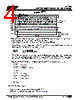
️· `LDL #k`: Load immediate value `k` into the L register.
️· `LDH #k`: Load immediate value `k` into the H register.
️· `STDMI`: Store immediate value into memory location pointed to by HL register
️· `ADDA`: Add
️· `SUBM`: Subtract
️· `LDASP`: Load Accumulator to Stack Pointer
️· `STASP`: Store Stack Pointer to Accumulator
️· `SEPL`: Set Port 4 bit pointed to by L register
6. Key Features/Limitations
️· Pros:
- Low power consumption.
- Designed for LCD control.
- Simple architecture (easier to learn and debug).
️· Cons:
- 4-bit data width: Slow and limited processing power.
- Limited RAM and Stack space.
- Limited instruction set (based on inference).
- Documentation is not very detailed or user-friendly.
Overall Impression
The EM73880 is a specialized, low-end microcontroller designed for LCD display applications in devices where power consumption and simplicity are priorities. It's not suitable for complex tasks or high-performance applications but can be effective for basic display control and related functions. The documentation is a reference guide rather than a teaching manual and requires some understanding of microcontroller fundamentals to use effectively.
1. General Overview
️· Target: This is a 4-bit microcontroller designed for LCD (Liquid Crystal Display) applications, specifically targeting control and display functionality. It's a relatively simple, low-power device.
️· Documentation Style: The documentation is a bit terse and uses a table/list-based approach. It's not a tutorial; it's more of a reference guide.
2. Core Architecture & Registers
️· Data Size: Operates on 4-bit data. This means it processes data in chunks of 4 bits, which is a limitation compared to 8-bit or 16-bit microcontrollers.
️· ALU (Arithmetic Logic Unit): Handles arithmetic (addition, subtraction) and logical operations. It has flags (CF - Carry Flag, ZF - Zero Flag, SF - Status Flag) to indicate the results of these operations.
️· HL Register: This is a crucial register. It serves multiple purposes:
- Pointer: Used for accessing RAM memory locations. (Memory address)
- Temporary Storage: Can be used to temporarily hold data during calculations.
- I/O Port Control: The lower nibble (L) can be used as a pointer to select bits of an I/O port (likely Port 4).
️· SP (Stack Pointer): Manages the stack, which is used for storing return addresses when calling subroutines and for temporary data. It's a 4-bit register, limiting the stack depth.
️· DP (Data Pointer): A 12-bit register that points to locations within ROM (Read-Only Memory). This is useful for accessing program code or constants stored in ROM.
️· HL Register: A pair of 4-bit registers used as a pointer and as temporary registers.
3. Memory and Addressing
️· RAM: Limited, but crucial for data storage. HL register functions as a memory pointer.
️· ROM: Used for program storage and constants. DP provides access.
️· Stack: Limited to a 4-bit depth due to the SP register.
4. Clock and Timing
️· Dual Clock System: A combination of low-frequency (from crystal or RC oscillator) and high-frequency internal clocks.
️· Clock Frequency: Low frequency (~32.768 kHz - suitable for low-power operation, often used in watches). The High frequency oscillator is built-in at 4.6 MHz.
️· Operating Modes:
- NORMAL: High-speed operation, suitable for demanding tasks (LCD display, sound processing).
- SLOW: Reduced speed, conserves power.
- IDLE: CPU stops, but LCD functionality might be maintained.
- STOP: All functionality disabled, lowest power consumption.
5. Instruction Set (Implied from Documentation)
While a full instruction set isn't explicitly listed, we can infer some instructions from the description:
️· `LDL #k`: Load immediate value `k` into the L register.
️· `LDH #k`: Load immediate value `k` into the H register.
️· `STDMI`: Store immediate value into memory location pointed to by HL register
️· `ADDA`: Add
️· `SUBM`: Subtract
️· `LDASP`: Load Accumulator to Stack Pointer
️· `STASP`: Store Stack Pointer to Accumulator
️· `SEPL`: Set Port 4 bit pointed to by L register
6. Key Features/Limitations
️· Pros:
- Low power consumption.
- Designed for LCD control.
- Simple architecture (easier to learn and debug).
️· Cons:
- 4-bit data width: Slow and limited processing power.
- Limited RAM and Stack space.
- Limited instruction set (based on inference).
- Documentation is not very detailed or user-friendly.
Overall Impression
The EM73880 is a specialized, low-end microcontroller designed for LCD display applications in devices where power consumption and simplicity are priorities. It's not suitable for complex tasks or high-performance applications but can be effective for basic display control and related functions. The documentation is a reference guide rather than a teaching manual and requires some understanding of microcontroller fundamentals to use effectively.
| Part No. | EM73880 |
| Manufacturer | EMC |
| Size | 222 Kbytes |
| Pages | 40 pages |
| Description | 4-BIT MICRO-CONTROLLER FOR LCD PRODUCT |
| ALLDATASHEET vous a-t-il été utile ? [ DONATE ] |
À propos de Alldatasheet | Publicité | Contactez-nous | Politique de confidentialité | Lien vers la fiche technique | Echange de liens | Fabricants All Rights Reserved©Alldatasheet.com |
| Russian : Alldatasheetru.com | Korean : Alldatasheet.co.kr | Spanish : Alldatasheet.es | French : Alldatasheet.fr | Italian : Alldatasheetit.com Portuguese : Alldatasheetpt.com | Polish : Alldatasheet.pl | Vietnamese : Alldatasheet.vn Indian : Alldatasheet.in | Mexican : Alldatasheet.com.mx | British : Alldatasheet.co.uk | New Zealand : Alldatasheet.co.nz |
|
Family Site : ic2ic.com |
icmetro.com |
 French ▼
  English
 Chinese
 German
 Japanese
 Russian
 Korean
 Spanish
 Italian
 Portuguese
 Polish
 Vietnamese
 Indian
 Mexican
 British
 New Zealand