 |
Moteur de recherche de fiches techniques de composants électroniques |
|
|
Moteur de recherche de fiches techniques de composants électroniques |
|
The question interval is too short.
Please try again in a few seconds.

Hello, Please ask a question about AL160815NJL Datasheet
# Example questions:
➢ What is the dc resistance (max) for the al160856njl□□□ inductor?
➢ What test frequency (mhz) is used for the srf minimum specification for all listed inductors?
➢ What is the rated current for the inductor with part number al16082n2dl□□□?
| Part No. | AL160815NJL |
| Manufacturer | ABC |
| Size | 85 Kbytes |
| Pages | 5 pages |
| Description | THIN FILM CHIP INDUCTOR |

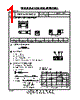
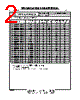
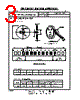
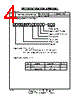
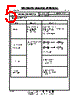

Here's a breakdown of the information and a summary:
1. Overall Structure:
️· Table Format: The information is presented in a tabular format, with multiple rows representing individual inductor models.
️· Datasheet Sections: The structure suggests sections for:
- Product Identification (Model Number - implied)
- Electrical Characteristics
- Physical Characteristics (not explicitly shown, but model numbers might relate to size/shape)
- Test Conditions (Test Frequency, SRF (Self-Resonant Frequency), Q (Quality Factor))
2. Key Columns & What They Represent (Based on context clues):
️· Model Number: (Implied - This would be the unique identifier for each inductor). The text includes model numbers like "AL160868NJL□-□□□" and "AL16081N0DL□-□□□".
️· Inductance (nH): The value of inductance in nanoHenries.
️· % Tolerance: The allowable variation from the nominal inductance value.
️· Test Frequency (MHz): The frequency at which the inductance and other electrical parameters were measured.
️· SRF (Self-Resonant Frequency) (GHz): The frequency at which the inductor's internal capacitance causes it to resonate, significantly reducing inductance. Higher SRF values are generally desirable.
️· Q (Quality Factor): A measure of the inductor's efficiency. Higher Q values indicate lower losses.
️· Rated Current (mA): The maximum DC current the inductor can handle without saturation or excessive heating.
️· DC Resistance (Ω): The resistance of the inductor's coil. Lower values are generally preferred for lower power loss.
3. Summary of Features/Observations (General):
️· Wide Range of Inductances: The inductors offer a range of inductance values (likely from a few nH to a few uH - based on model numbers, there are 0.8uH, 1.0uH, and above 10 uH).
️· Variety of Tolerances: The % Tolerance column indicates a variety of allowable deviations, likely affecting suitability for different applications.
️· Focus on High Frequency: The test frequencies typically range from 10 MHz to 130 MHz, indicating these are designed for applications involving moderate to high frequencies.
️· SRF and Q: These parameters are crucial for high-frequency performance. The SRF value should be significantly higher than the operating frequency, and a high Q is desirable to minimize losses.
️· Current Handling: The "Rated Current" column is important for power applications, where the inductor must not saturate or overheat.
️· Size Variations: The model numbers probably encode size/footprint information, such as 0805, 0603 or even 1206.
4. Potential Applications (Inferred):
Based on these features, these inductors are likely suitable for a variety of applications including:
️· RF Circuits: Wireless communication, filters, impedance matching.
️· Power Management: DC-DC converters, filtering.
️· Signal Processing: Signal conditioning, noise filtering.
️· Impedance Matching Networks: Matching antenna impedance to transmission line impedance.
️· EMI (Electromagnetic Interference) Filtering
️· Mobile Devices: Filters for Cellular, Wi-Fi
Important Caveats:
️· Missing Information: This analysis is based on limited data. A complete datasheet would provide more detail, including:
- Explicit column labels and units
- Operating temperature range
- Packaging information
- Physical dimensions.
️· Model Number Encoding: The precise meaning of the model numbers (e.g., size, core material) is unknown without additional documentation.
Here's a breakdown of the information and a summary:
1. Overall Structure:
️· Table Format: The information is presented in a tabular format, with multiple rows representing individual inductor models.
️· Datasheet Sections: The structure suggests sections for:
- Product Identification (Model Number - implied)
- Electrical Characteristics
- Physical Characteristics (not explicitly shown, but model numbers might relate to size/shape)
- Test Conditions (Test Frequency, SRF (Self-Resonant Frequency), Q (Quality Factor))
2. Key Columns & What They Represent (Based on context clues):
️· Model Number: (Implied - This would be the unique identifier for each inductor). The text includes model numbers like "AL160868NJL□-□□□" and "AL16081N0DL□-□□□".
️· Inductance (nH): The value of inductance in nanoHenries.
️· % Tolerance: The allowable variation from the nominal inductance value.
️· Test Frequency (MHz): The frequency at which the inductance and other electrical parameters were measured.
️· SRF (Self-Resonant Frequency) (GHz): The frequency at which the inductor's internal capacitance causes it to resonate, significantly reducing inductance. Higher SRF values are generally desirable.
️· Q (Quality Factor): A measure of the inductor's efficiency. Higher Q values indicate lower losses.
️· Rated Current (mA): The maximum DC current the inductor can handle without saturation or excessive heating.
️· DC Resistance (Ω): The resistance of the inductor's coil. Lower values are generally preferred for lower power loss.
3. Summary of Features/Observations (General):
️· Wide Range of Inductances: The inductors offer a range of inductance values (likely from a few nH to a few uH - based on model numbers, there are 0.8uH, 1.0uH, and above 10 uH).
️· Variety of Tolerances: The % Tolerance column indicates a variety of allowable deviations, likely affecting suitability for different applications.
️· Focus on High Frequency: The test frequencies typically range from 10 MHz to 130 MHz, indicating these are designed for applications involving moderate to high frequencies.
️· SRF and Q: These parameters are crucial for high-frequency performance. The SRF value should be significantly higher than the operating frequency, and a high Q is desirable to minimize losses.
️· Current Handling: The "Rated Current" column is important for power applications, where the inductor must not saturate or overheat.
️· Size Variations: The model numbers probably encode size/footprint information, such as 0805, 0603 or even 1206.
4. Potential Applications (Inferred):
Based on these features, these inductors are likely suitable for a variety of applications including:
️· RF Circuits: Wireless communication, filters, impedance matching.
️· Power Management: DC-DC converters, filtering.
️· Signal Processing: Signal conditioning, noise filtering.
️· Impedance Matching Networks: Matching antenna impedance to transmission line impedance.
️· EMI (Electromagnetic Interference) Filtering
️· Mobile Devices: Filters for Cellular, Wi-Fi
Important Caveats:
️· Missing Information: This analysis is based on limited data. A complete datasheet would provide more detail, including:
- Explicit column labels and units
- Operating temperature range
- Packaging information
- Physical dimensions.
️· Model Number Encoding: The precise meaning of the model numbers (e.g., size, core material) is unknown without additional documentation.
| Part No. | AL160815NJL |
| Manufacturer | ABC |
| Size | 85 Kbytes |
| Pages | 5 pages |
| Description | THIN FILM CHIP INDUCTOR |
| ALLDATASHEET vous a-t-il été utile ? [ DONATE ] |
À propos de Alldatasheet | Publicité | Contactez-nous | Politique de confidentialité | Lien vers la fiche technique | Echange de liens | Fabricants All Rights Reserved©Alldatasheet.com |
| Russian : Alldatasheetru.com | Korean : Alldatasheet.co.kr | Spanish : Alldatasheet.es | French : Alldatasheet.fr | Italian : Alldatasheetit.com Portuguese : Alldatasheetpt.com | Polish : Alldatasheet.pl | Vietnamese : Alldatasheet.vn Indian : Alldatasheet.in | Mexican : Alldatasheet.com.mx | British : Alldatasheet.co.uk | New Zealand : Alldatasheet.co.nz |
|
Family Site : ic2ic.com |
icmetro.com |
 French ▼
  English
 Chinese
 German
 Japanese
 Russian
 Korean
 Spanish
 Italian
 Portuguese
 Polish
 Vietnamese
 Indian
 Mexican
 British
 New Zealand