Moteur de recherche de fiches techniques de composants électroniques
  French  ▼
ALLDATASHEET.FR

X  

AD8605ARTZ Datasheet with Chat AI
  • AIauthorized

    Hello, Please ask a question about AD8605ARTZ Datasheet

  • # Example questions: ➢ If you needed an amplifier with the lowest input capacitance, which input capacitance value (ccom or cdiff) would you prioritize, and what is the typical value for that capacitance?
    ➢ What is the maximum allowed junction temperature for all packages, and what package type offers the best thermal performance (lowest θja)?
    ➢ Compare the typical supply current (isy) for the ad8605/ad8606 and ad8608 amplifiers. what are the typical values and what does this suggest about their power consumption?

  • Part No.AD8605ARTZ
    ManufacturerAD
    Size836 Kbytes
    Pages24 pages
    DescriptionPrecision, Low Noise, CMOS, Rail-to-Rail, Input/Output Operational Amplifiers
    Datasheet Summary with AI

    1. General Information and Series Overview

    ️· Devices: AD8605, AD8606, AD8608 (all part of the same family).
    ️· Type: Precision, low-noise, low-power operational amplifiers.
    ️· Applications: Suitable for a variety of signal conditioning, data acquisition, and instrumentation applications.

    2. Absolute Maximum Ratings

    Parameter Rating Notes
    Supply Voltage 6 V
    Input Voltage GND to VS
    Differential Input Voltage 6 V
    Output Short-Circuit Duration See Derating Curves Important to avoid long shorts.
    Storage Temperature Range -65°C to +150°C
    Operating Temperature Range -40°C to +125°C
    Junction Temperature Range -65°C to +150°C
    Lead Temperature (Soldering) 300°C (60 sec)

    Important Note: These are *maximum* ratings. Exceeding them can cause permanent damage.

    3. Thermal Resistance

    The thermal resistance values are crucial for determining the power dissipation and operating temperature of the chip in a given application. These values depend heavily on the package type (e.g., WLCSP, SOT-23, SOIC). The tables provide θJA (junction-to-ambient) and θJC (junction-to-case) values for various packages. You'll need to consult the complete datasheet for the specific package you're using.

    4. Electrical Characteristics (at 2.7V and 5V Supply Voltages - Key Specs Highlighted)

    *See Tables 3 & 3 of the PDF.* This section is the most complex and contains a wealth of information. I'll provide a summary of the most essential characteristics. Note the variations between supply voltages (2.7V and 5V). *These values may vary between the models (AD8605, 8606, 8608).* I will flag where I can distinguish them.

    Key Parameters (Representative Values - Check the datasheet for complete details for each model):

    Parameter Typical Value Units
    Supply Voltage Range 2.7V to 5.5V V
    Input Offset Voltage 20 µV (8605), 65 µV (8606), 80 µV (8608) µV
    Input Bias Current 0.2 pA (8605), 1 pA (8606), 300 pA (8608) pA
    Input Offset Current Noise 6.5 fA/sqrt(Hz) fA/sqrt(Hz)
    Voltage Noise Density (0.1 Hz to 10 Hz) 6.5 nV/sqrt(Hz) nV/sqrt(Hz)
    Current Noise Density 0.01 pA/sqrt(Hz) pA/sqrt(Hz)
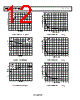
    Slew Rate 5 V/µs V/µs
    Unity Gain Bandwidth 9 MHz MHz
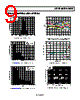
    Input Common-Mode Range -0.5 V to +4.5 V (typical) V
    Common-Mode Rejection Ratio (CMRR) 110 dB (typical) dB
    Power Supply Rejection Ratio (PSRR) 92 dB (typical) dB
    Slew Rate 5 V/µs V/µs
    Gain Bandwidth Product 9 MHz MHz
    Output Voltage Swing Varies with supply V


    Differences between models (AD8605, 8606, 8608):

    ️· Input Offset Voltage: Significantly varies between the models, with the AD8605 having the lowest (20 µV) and AD8608 having the highest (80 µV).
    ️· Input Bias Current: Follows a similar trend.
    ️· Gain Bandwidth Product: 9MHz for all models.

    5. Package Information

    The datasheets list various package options (WLCSP, SOT-23, MSOP, SOIC, TSSOP). Refer to the complete datasheet for detailed package dimensions and pinouts.

    Important Notes & Recommendations:

    ️· Datasheet is Essential: The information provided here is a summary. The complete datasheets are absolutely essential for detailed design and application.
    ️· Application-Specific Considerations: The optimal operating conditions and performance will depend on the specific application.
    ️· Thermal Management: Pay close attention to thermal management, particularly in high-power applications. Use the thermal resistance values to calculate the junction temperature and ensure that it remains within acceptable limits.
    ️· Power Supply Decoupling: Proper power supply decoupling is crucial for stable operation.
    ️· ESD Precautions: Handle the devices with appropriate ESD precautions.

    1. General Information and Series Overview

    ️· Devices: AD8605, AD8606, AD8608 (all part of the same family).
    ️· Type: Precision, low-noise, low-power operational amplifiers.
    ️· Applications: Suitable for a variety of signal conditioning, data acquisition, and instrumentation applications.

    2. Absolute Maximum Ratings

    Parameter Rating Notes
    Supply Voltage 6 V
    Input Voltage GND to VS
    Differential Input Voltage 6 V
    Output Short-Circuit Duration See Derating Curves Important to avoid long shorts.
    Storage Temperature Range -65°C to +150°C
    Operating Temperature Range -40°C to +125°C
    Junction Temperature Range -65°C to +150°C
    Lead Temperature (Soldering) 300°C (60 sec)

    Important Note: These are *maximum* ratings. Exceeding them can cause permanent damage.

    3. Thermal Resistance

    The thermal resistance values are crucial for determining the power dissipation and operating temperature of the chip in a given application. These values depend heavily on the package type (e.g., WLCSP, SOT-23, SOIC). The tables provide θJA (junction-to-ambient) and θJC (junction-to-case) values for various packages. You'll need to consult the complete datasheet for the specific package you're using.

    4. Electrical Characteristics (at 2.7V and 5V Supply Voltages - Key Specs Highlighted)

    *See Tables 3 & 3 of the PDF.* This section is the most complex and contains a wealth of information. I'll provide a summary of the most essential characteristics. Note the variations between supply voltages (2.7V and 5V). *These values may vary between the models (AD8605, 8606, 8608).* I will flag where I can distinguish them.

    Key Parameters (Representative Values - Check the datasheet for complete details for each model):

    Parameter Typical Value Units
    Supply Voltage Range 2.7V to 5.5V V
    Input Offset Voltage 20 µV (8605), 65 µV (8606), 80 µV (8608) µV
    Input Bias Current 0.2 pA (8605), 1 pA (8606), 300 pA (8608) pA
    Input Offset Current Noise 6.5 fA/sqrt(Hz) fA/sqrt(Hz)
    Voltage Noise Density (0.1 Hz to 10 Hz) 6.5 nV/sqrt(Hz) nV/sqrt(Hz)
    Current Noise Density 0.01 pA/sqrt(Hz) pA/sqrt(Hz)
    Slew Rate 5 V/µs V/µs
    Unity Gain Bandwidth 9 MHz MHz
    Input Common-Mode Range -0.5 V to +4.5 V (typical) V
    Common-Mode Rejection Ratio (CMRR) 110 dB (typical) dB
    Power Supply Rejection Ratio (PSRR) 92 dB (typical) dB
    Slew Rate 5 V/µs V/µs
    Gain Bandwidth Product 9 MHz MHz
    Output Voltage Swing Varies with supply V


    Differences between models (AD8605, 8606, 8608):

    ️· Input Offset Voltage: Significantly varies between the models, with the AD8605 having the lowest (20 µV) and AD8608 having the highest (80 µV).
    ️· Input Bias Current: Follows a similar trend.
    ️· Gain Bandwidth Product: 9MHz for all models.

    5. Package Information

    The datasheets list various package options (WLCSP, SOT-23, MSOP, SOIC, TSSOP). Refer to the complete datasheet for detailed package dimensions and pinouts.

    Important Notes & Recommendations:

    ️· Datasheet is Essential: The information provided here is a summary. The complete datasheets are absolutely essential for detailed design and application.
    ️· Application-Specific Considerations: The optimal operating conditions and performance will depend on the specific application.
    ️· Thermal Management: Pay close attention to thermal management, particularly in high-power applications. Use the thermal resistance values to calculate the junction temperature and ensure that it remains within acceptable limits.
    ️· Power Supply Decoupling: Proper power supply decoupling is crucial for stable operation.
    ️· ESD Precautions: Handle the devices with appropriate ESD precautions.

    Part No.AD8605ARTZ
    ManufacturerAD
    Size836 Kbytes
    Pages24 pages
    DescriptionPrecision, Low Noise, CMOS, Rail-to-Rail, Input/Output Operational Amplifiers
    ALLDATASHEET vous a-t-il été utile ?  [ DONATE ] 

    À propos de Alldatasheet   |   Publicité   |   Contactez-nous   |   Politique de confidentialité   |   Lien vers la fiche technique    |   Echange de liens   |   Fabricants
    All Rights Reserved©Alldatasheet.com


    Mirror Sites
    English : Alldatasheet.com  |   English : Alldatasheet.net  |   Chinese : Alldatasheetcn.com  |   German : Alldatasheetde.com  |   Japanese : Alldatasheet.jp
    Russian : Alldatasheetru.com  |   Korean : Alldatasheet.co.kr  |   Spanish : Alldatasheet.es  |   French : Alldatasheet.fr  |   Italian : Alldatasheetit.com
    Portuguese : Alldatasheetpt.com  |   Polish : Alldatasheet.pl  |   Vietnamese : Alldatasheet.vn
    Indian : Alldatasheet.in  |   Mexican : Alldatasheet.com.mx  |   British : Alldatasheet.co.uk  |   New Zealand : Alldatasheet.co.nz
    Family Site : ic2ic.com  |   icmetro.com