 |
Moteur de recherche de fiches techniques de composants électroniques |
|
|
Moteur de recherche de fiches techniques de composants électroniques |
|
The question interval is too short.
Please try again in a few seconds.

Hello, Please ask a question about MCP6L712 Datasheet
# Example questions:
➢ What is the typical common-mode input voltage range, as depicted in figure 2-5?
➢ What is the supply voltage (vdd) used in figure 2-3 for testing input offset voltage vs output voltage?
➢ Are the performance characteristics listed tested or guaranteed, and what does the note regarding the graphs and tables indicate?
| Part No. | MCP6L712 |
| Manufacturer | MICROCHIP |
| Size | 934 Kbytes |
| Pages | 40 pages |
| Description | 2 MHz, 150 μA Op Amps |








Okay, here's a breakdown and summary of the information extracted from the provided text. I'm structuring it to be useful, pulling out key specifications and insights.
1. Device Information
️· Device Name: MCP6L71/1R/2/4 (This indicates a family of devices; subtle differences between them might exist.)
️· Manufacturer: Microchip Technology Inc.
2. Key Features & General Information
️· Operational Amplifier (Op-Amp) Family: These are low-power op-amps, designed with features suitable for applications needing efficiency.
️· Datasheet Focus: The document is a datasheet, providing technical specifications and performance characteristics.
️· Statistical Summary: The typical performance curves and tables are NOT guaranteed values. They are based on a limited sample size and provided for informational purposes only.
3. Electrical Characteristics (Summary - Important Specs)
️· Power Supply Voltage (V<sub>DD</sub>): It appears to support a range, with examples given as 2.0V and 5.5V.
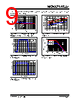
️· Input Offset Voltage (V<sub>OS</sub>): This is a crucial parameter for precision applications. The datasheet presents graphs showing how V<sub>OS</sub> varies with common-mode input voltage and output voltage (see Figure 2-2 & 2-3).
️· Common-Mode Range (CMR): Shown in Figure 2-4.
️· Common-Mode Rejection Ratio (CMRR): This indicates the op-amp’s ability to reject signals common to both inputs. Figure 2-5 shows CMRR vs. Temperature.
️· Power Supply Rejection Ratio (PSRR): Indicates how well the op-amp rejects variations in the power supply voltage. Figure 2-6 shows PSRR vs. Frequency.
️· Temperature Range: It is suggested through figures that there's a range from -5°C to +125°C.
4. Figures & Graphs - What they Show:
️· Figure 2-1 & 2-2: Input Offset Voltage vs. Common-Mode Input Voltage (at V<sub>DD</sub> = 2.0V and 5.5V, respectively). This helps understand the input offset voltage's dependence on the common-mode voltage.
️· Figure 2-3: Input Offset Voltage vs. Output Voltage. This shows how the input offset voltage is influenced by the output voltage level.
️· Figure 2-4: CMRR vs. Temperature
️· Figure 2-5: Input Common-mode Range vs. Temperature
️· Figure 2-6: CMRR, PSRR vs. Frequency
5. Important Considerations & Notes
️· Typical Performance: The curves are not guaranteed. Real-world performance may vary.
️· Datasheet is a Guide: Use the datasheet in conjunction with proper design practices and application-specific testing.
To help me provide a more tailored response, could you tell me:
* What specific application are you considering using the MCP6L71 for?
* What are your most critical performance requirements (e.g., accuracy, power consumption)?
1. Device Information
️· Device Name: MCP6L71/1R/2/4 (This indicates a family of devices; subtle differences between them might exist.)
️· Manufacturer: Microchip Technology Inc.
2. Key Features & General Information
️· Operational Amplifier (Op-Amp) Family: These are low-power op-amps, designed with features suitable for applications needing efficiency.
️· Datasheet Focus: The document is a datasheet, providing technical specifications and performance characteristics.
️· Statistical Summary: The typical performance curves and tables are NOT guaranteed values. They are based on a limited sample size and provided for informational purposes only.
3. Electrical Characteristics (Summary - Important Specs)
️· Power Supply Voltage (V<sub>DD</sub>): It appears to support a range, with examples given as 2.0V and 5.5V.
️· Input Offset Voltage (V<sub>OS</sub>): This is a crucial parameter for precision applications. The datasheet presents graphs showing how V<sub>OS</sub> varies with common-mode input voltage and output voltage (see Figure 2-2 & 2-3).
️· Common-Mode Range (CMR): Shown in Figure 2-4.
️· Common-Mode Rejection Ratio (CMRR): This indicates the op-amp’s ability to reject signals common to both inputs. Figure 2-5 shows CMRR vs. Temperature.
️· Power Supply Rejection Ratio (PSRR): Indicates how well the op-amp rejects variations in the power supply voltage. Figure 2-6 shows PSRR vs. Frequency.
️· Temperature Range: It is suggested through figures that there's a range from -5°C to +125°C.
4. Figures & Graphs - What they Show:
️· Figure 2-1 & 2-2: Input Offset Voltage vs. Common-Mode Input Voltage (at V<sub>DD</sub> = 2.0V and 5.5V, respectively). This helps understand the input offset voltage's dependence on the common-mode voltage.
️· Figure 2-3: Input Offset Voltage vs. Output Voltage. This shows how the input offset voltage is influenced by the output voltage level.
️· Figure 2-4: CMRR vs. Temperature
️· Figure 2-5: Input Common-mode Range vs. Temperature
️· Figure 2-6: CMRR, PSRR vs. Frequency
5. Important Considerations & Notes
️· Typical Performance: The curves are not guaranteed. Real-world performance may vary.
️· Datasheet is a Guide: Use the datasheet in conjunction with proper design practices and application-specific testing.
| Part No. | MCP6L712 |
| Manufacturer | MICROCHIP |
| Size | 934 Kbytes |
| Pages | 40 pages |
| Description | 2 MHz, 150 μA Op Amps |
| ALLDATASHEET vous a-t-il été utile ? [ DONATE ] |
À propos de Alldatasheet | Publicité | Contactez-nous | Politique de confidentialité | Lien vers la fiche technique | Echange de liens | Fabricants All Rights Reserved©Alldatasheet.com |
| Russian : Alldatasheetru.com | Korean : Alldatasheet.co.kr | Spanish : Alldatasheet.es | French : Alldatasheet.fr | Italian : Alldatasheetit.com Portuguese : Alldatasheetpt.com | Polish : Alldatasheet.pl | Vietnamese : Alldatasheet.vn Indian : Alldatasheet.in | Mexican : Alldatasheet.com.mx | British : Alldatasheet.co.uk | New Zealand : Alldatasheet.co.nz |
|
Family Site : ic2ic.com |
icmetro.com |
 French ▼
  English
 Chinese
 German
 Japanese
 Russian
 Korean
 Spanish
 Italian
 Portuguese
 Polish
 Vietnamese
 Indian
 Mexican
 British
 New Zealand